Key Takeaways
- The building is the small part. Most hours go into discovery — establishing what the process really is, as opposed to what the process document says it is.
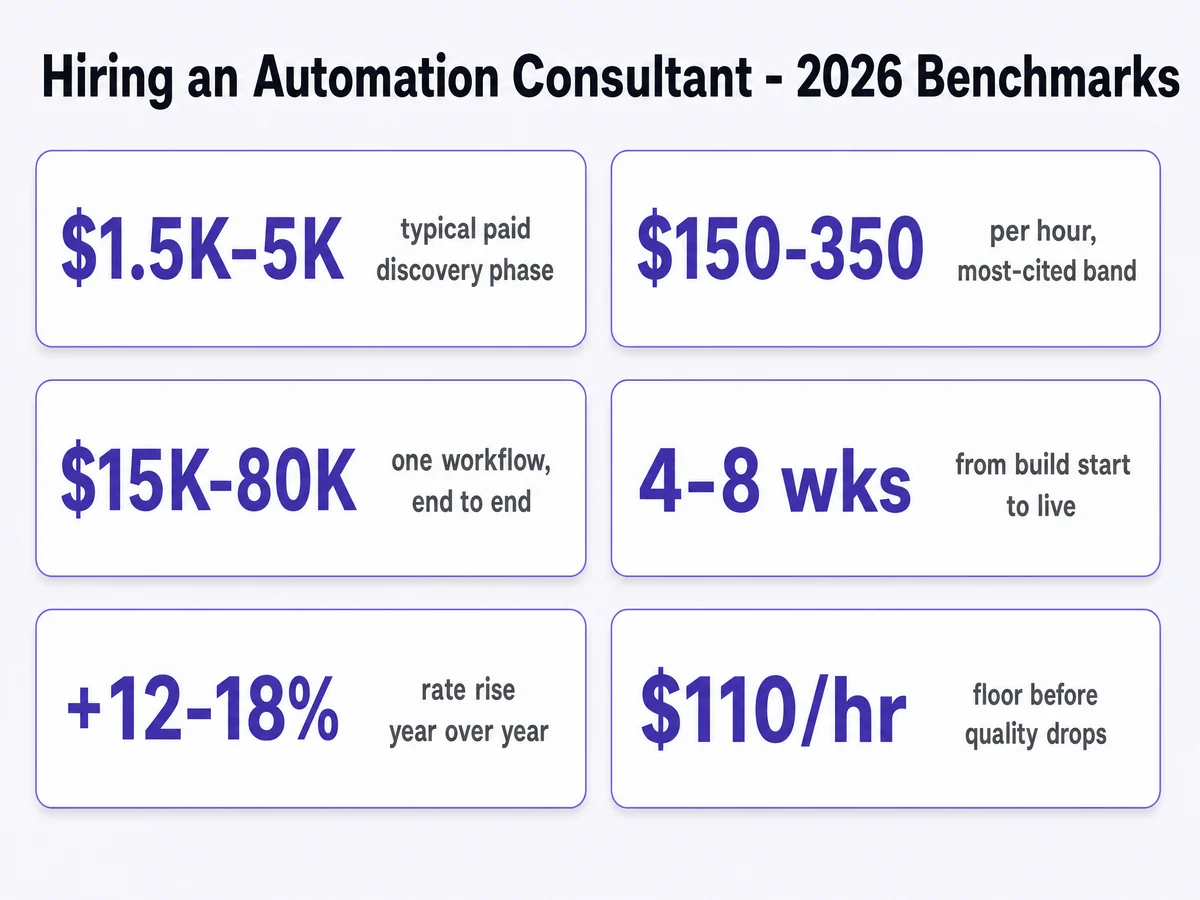
- Discovery is now usually a separate paid phase. Published 2026 pricing guides put it at roughly $1,500 to $5,000 as a fixed fee, producing a written scope before any build is agreed.
- Hourly rates cluster at $150–350, but treat every published rate as seller-side marketing — almost all of it is consultancies describing their own pricing, not independent survey data.
- A good consultant refuses work: undocumented processes, low-volume tasks, and anything whose payback only survives on optimistic assumptions.
- The clearest quality signal is conversational order. Naming a tool before asking how the work happens is selling; asking what happens on an unusual case is consulting.
- MIT's NANDA initiative found roughly 95% of generative AI pilots produced no measurable P&L impact — scoping failures, not technology failures, which is precisely the gap this role exists to close.
- Hourly billing suits discovery and suits implementation badly: it pays a consultant to be slow.
The job title is doing a lot of hiding. “Automation consultant” covers everything from a solo freelancer wiring up two apps to a partner at a large firm producing a slide deck, and the word offers no clue which one is in front of you.
So here is the version from the delivery side: what the hours are actually spent on, what a real engagement looks like week by week, and the questions that separate someone doing the work from someone selling a tool.
What Does an Automation Consultant Actually Do?
Four things, in this order. The order matters more than the list.
1. Find out what the process really is. Not what the process document says, and not what the owner believes. The actual sequence, including the undocumented step where somebody checks a spreadsheet before approving, and the exception that happens twice a week that nobody mentions because it is normal to them. This is the bulk of the work and the part clients are most surprised by.
2. Decide what is worth automating. Which is mostly deciding what is not. Ranking candidates on frequency, consistency and consequence is a mechanical exercise once the process is visible — we set out the scoring sheet in how do I know what to automate first.
3. Design and build it, or oversee someone who does. Tool selection sits here, at step three, not step one. A consultant who leads with a platform name has skipped the two steps that determine whether the platform matters.
4. Hand it over so it survives. A named owner, a visible exception queue, credentials you hold, and a written support arrangement. Skipping this is the single most common way a working automation becomes a dead one — see who maintains my AI automation after it's built.
Why Is Most of the Job Not Building?
Because the building is the part with the fewest unknowns. Connecting a form to a CRM is a solved problem. Establishing which form, which fields, which exceptions, and who decides when the data is ambiguous — that is where projects actually fail.
The failure statistics support this reading. MIT's NANDA initiative found roughly 95% of generative AI pilots produced no measurable P&L impact, and Gartner expects over 40% of agentic AI projects to be cancelled by the end of 2027 on cost, unclear value and weak risk controls. Neither is a claim that the technology does not work. Both describe decisions made before any code was written.
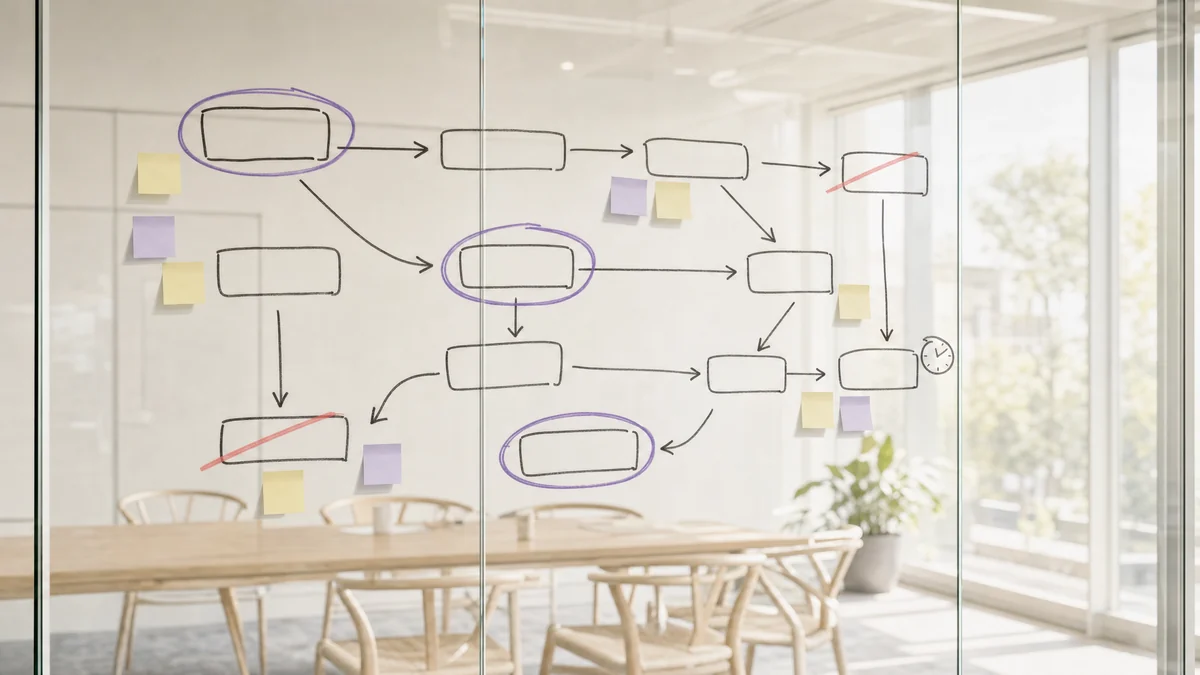
Which is why the deliverable that matters most from a good engagement is not software. It is a map of your process with honest marks on it: this one, not that one, not yet on this.
What Does a Real Automation Engagement Look Like?
Published guides converge on six weeks for a small first project: two weeks of discovery and planning, two of implementation, two of training and handover, with most builds going live four to eight weeks after the build phase starts. That shape matches what we see, with one caveat — the discovery fortnight stretches when the process turns out to be undocumented, which is often.
| Phase | What you should receive | Typical basis | Red flag |
|---|---|---|---|
| Discovery | Written process map, scored shortlist, a scope you own | Fixed fee | Free, and bundled into the build |
| Build | One working workflow, documented, credentials in your name | Fixed fee | Billed hourly with an open end |
| Handover | Named owner, exception queue, health check, support terms | Included | Not mentioned in the proposal |
| Ongoing | Monitoring, fixes when vendors change things | Retainer or per-incident | Assumed, never priced |
What Should an Automation Consultant Talk You Out Of?
This is the part that separates the role from order-taking. Four things a good one pushes back on:
- A process nobody has written down. Automating it scales its inconsistencies at machine speed. The first deliverable becomes a written process, which is less exciting and considerably more useful.
- Work that does not happen often enough. Volume is what creates payback. A painful monthly task usually loses to a trivial daily one, and owners consistently rank these the wrong way round.
- Judgment work. Pricing, negotiation and complaint handling are what customers pay you for — the boundary is mapped in what you can actually automate with AI.
- A business case that only survives on optimistic inputs. Run it on the pessimistic assumption instead. Is AI automation worth it works through that arithmetic.
A consultant who talks you out of a five-figure build that would not have paid back has just delivered more value than one who cheerfully builds it. That is uncomfortable to price and it is still true.
What Does It Cost to Hire One?
Published 2026 guides land in a consistent band: roughly $150 to $350 an hour for combined strategy and implementation, with boutique firms at the lower end and large-firm partners well above it. Single-workflow projects run from about $15,000, and retainers from about $5,000 a month.
Two things those headline rates routinely omit. Running costs — licences and API usage that continue after handover, commonly turning a $10,000 project into $12,000–14,000 in year one. And maintenance, which is not optional. Our own cost breakdown for small business covers both.
On billing model: hourly is reasonable for discovery, where the work genuinely is open-ended. It is a poor fit for implementation, because a consultant who finishes early earns less. For a defined build, fixed fee puts the incentive on the right side of the table.
How Is This Different From an Agency, a Freelancer or Doing It Yourself?
| Option | Best when | Main risk |
|---|---|---|
| Consultant | You are not yet sure what to automate, or whether to | Paying for thinking you could have done yourself |
| Agency | Scope is known and you want capacity behind it | Scope is rarely as known as it looks |
| Freelancer | One narrow, well-specified job | No continuity when they move on |
| Do it yourself | Low volume, one job, someone in-house enjoys it | Maintenance lands on the person who built it |
The honest framing: the value of a consultant is concentrated in the choosing and the keeping-alive, not the building. If you already know exactly what to build and you have someone to own it afterwards, you may not need one. We argue that case in can I build my own AI automation, and the adjacent hire-or-automate question in AI automation vs hiring.
How Do You Tell a Good One From a Bad One?
Listen to the order of the first conversation. It is a remarkably reliable signal.
- Do they ask about the process before naming a tool? A platform recommendation in the first ten minutes means the recommendation preceded the diagnosis.
- Do they ask what happens on an unusual case? Exceptions are where automations die. Someone who never asks has not run one in production.
- Do they ask who will own it? If nobody asks this before launch, nobody owns it after.
- Will they quote discovery separately? A fixed-fee scoping phase you own outright is a sign of confidence, not an upsell.
- Do they say no to anything? An engagement where every idea is a good idea is a sales call wearing a lanyard.
One more, on terminology: ask whether they are selling you an automation or an agent, and what the difference costs. If the answer is vague, AI agent vs automation has the three-question test.
How We Sourced This
Our own delivery data. Avelle scopes, builds and maintains automations for clinics, trades and multi-location retail in British Columbia, so the engagement shape and the failure modes here are first-party.
Published pricing guides from jahanzaib.ai, Layer3 Labs and Alice Labs, plus role descriptions from Upwork and ProsperSpark. We flag the obvious weakness in that evidence base: these are sellers publishing their own rate cards. There is no independent survey for this role, so every figure here is directional and none of it should be used as a hard benchmark.
Published research from MIT's NANDA initiative and Gartner for the failure and cancellation figures, cited inline. Where we could not source a number, we left the claim out. For definitions, start with what is AI automation; for the delivery side, workflow automation.
Frequently Asked Questions
They work out which parts of your business are worth automating, design how it should work, build or oversee the build, and hand it over with an owner named. In practice most of the hours go into understanding the process, not writing the automation.
No. A developer builds what you specify. A consultant's main job is deciding what should be specified, which includes telling you when the answer is nothing. The build is often the smallest part of the engagement.
Published 2026 guides cluster around 150 to 350 US dollars an hour, with a paid discovery phase of roughly 1,500 to 5,000 dollars and single-workflow projects from about 15,000. Treat those as directional: nearly all of them are published by consultancies about their own pricing.
Usually yes, and that is a good sign rather than a bad one. Fixed-fee discovery produces a written scope before anyone commits to a build, which is what stops the build estimate from being aspirational.
Hourly suits discovery, where the work is genuinely open-ended. It suits implementation badly, because a consultant who finishes early earns less. For a defined build, a fixed fee puts the efficiency incentive on the right side.
Automate a process nobody has written down, automate something too infrequent to pay back, promise a payback that only works on optimistic assumptions, or hand over a system with no named owner. Refusing work is a large part of doing the job properly.
Watch the order of the conversation. Someone who names a tool before asking how the process works is selling a product. Someone who asks what happens when a case is unusual, and who owns it on a Tuesday, is doing the job.
If one narrow job is clearly defined and your volume is modest, off-the-shelf tools plus your own time can work. The value of a consultant is concentrated in the choosing and the keeping-alive, not the building.
Want the Discovery Conversation First?
Book a free 30-minute call. We will map your repeat work, tell you which single job has the clearest payback, and say so plainly if the honest answer is that you do not need us yet.
Book Your Free AI Assessment →