
Key Takeaways
- Most small businesses do not have an automation problem, they have a prioritisation problem — there are usually thirty candidates and only one that should go first.
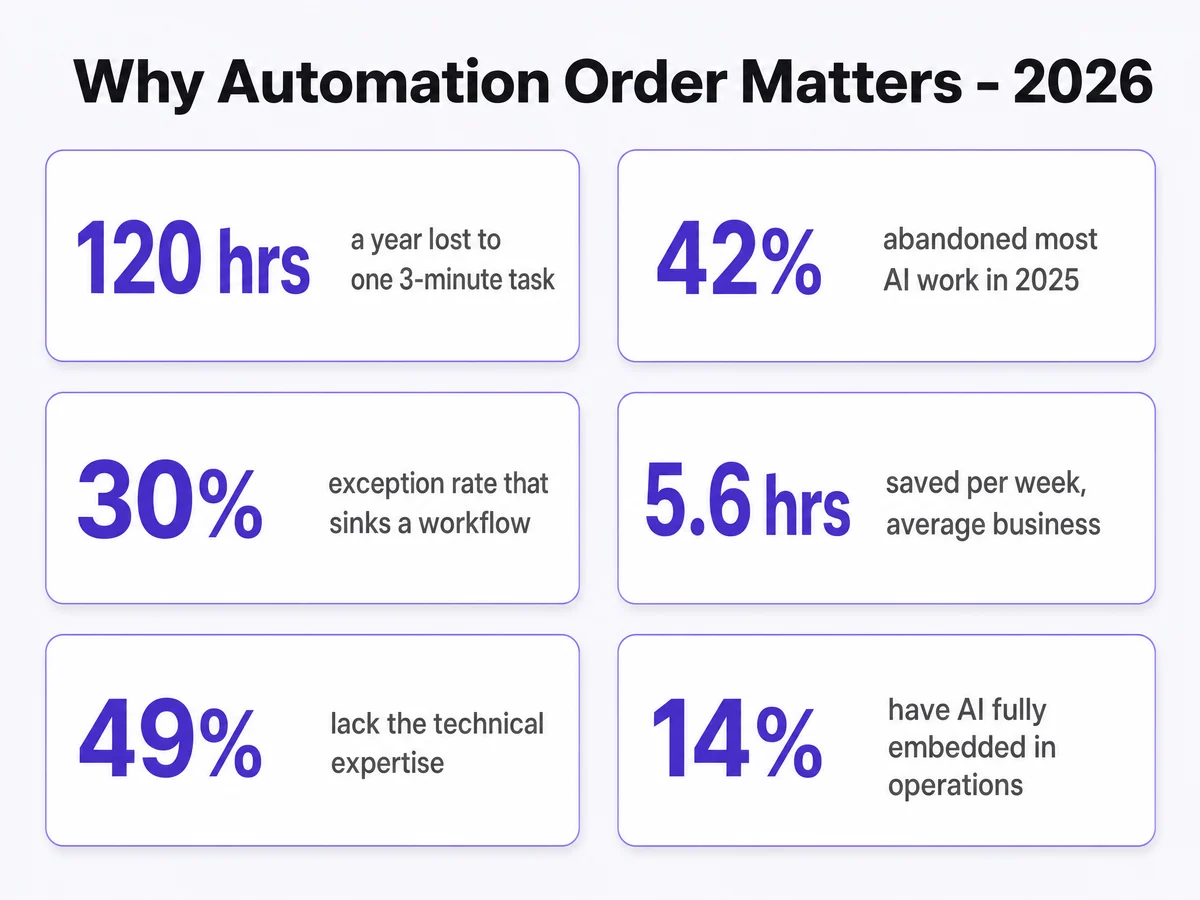
- Score on aggregate time, not per-instance time. A three-minute task done 200 times a month is 120 hours a year.
- Readiness is a gate, not a criterion: if the process is not written down, it is not eligible at any score.
- A workflow needing human judgment in more than roughly a third of cases is a poor first candidate — staff route around it and revert to manual.
- S&P Global found 42% of companies abandoned most of their AI initiatives in 2025, up from 17% the year before; picking the wrong first job is a common route into that statistic.
- Pick one. Ship it, measure a single number for a month, name an owner, then reconsider the list.
- Goldman Sachs found 49% of small businesses using AI lack the technical expertise to use it well (1,256 owners, February 2026), which is why the first pick should be the one you can live with maintaining.
The honest answer to this question is not a list of tasks. It is a scoring sheet, because the right first automation depends on numbers only you have: how often a thing happens in your business, and what it costs you when it does not.
What follows is the sheet we use on discovery calls, the bands we read it against, and a worked example. It takes about an hour to fill in.
Why Does the Order You Automate In Matter?
Because the first automation funds the second, politically as much as financially. Get it right and you have a number to point at when you propose the next one. Get it wrong and everyone in the building quietly concludes this stuff does not work.
The data backs the caution. S&P Global found 42% of companies abandoned most of their AI initiatives in 2025, up sharply from 17% the year before, and MIT’s NANDA initiative reported that roughly 95% of generative AI pilots showed no measurable P&L impact. Those are not mostly technology failures. They are selection failures.
How Do You Find the Candidates?
For one week, log every task anyone repeats. Not a time-and-motion study — a list, written as you go, without judging anything. Three prompts get most of it out:
- What did you have to look up or retype today that you have looked up before?
- What question did a customer ask that you have answered this week already?
- What did you not get to, that you meant to?
That third one matters more than it looks. The most valuable automations are usually jobs nobody is doing at all — quote follow-up, review requests, after-hours calls — rather than jobs being done slowly.
Then convert each to annual hours: minutes per instance × instances per year ÷ 60. Do this before you form any opinions. Appointment confirmations at three minutes each feel trivial; at 200 a month they are 120 hours a year, which is three working weeks.
The real problem is not the tool complexity. It is that nobody sat with them to map the actual workflow before touching any software. What works is starting with one repetitive task they hate doing, writing it out as plain steps on paper, then asking “which step could a computer do if someone told it exactly what to do?”
— r/automationHow Do You Score What to Automate First?
Five criteria, one to three points each, fifteen maximum. Score fast and do not agonise — the ranking is robust to being roughly right.
| Criterion | 3 points | 2 points | 1 point |
|---|---|---|---|
| Frequency How often it happens | Daily or more | Weekly | Monthly or less |
| Time cost Per single instance | Over 30 minutes | 5–30 minutes | Under 5 minutes |
| Consistency Do the steps vary? | Identical every time | Mostly the same | Varies a lot |
| Cost of a miss What happens if it is skipped | Lost revenue or a lost customer | Rework or a delay | Little real harm |
| Readiness Is it documented? | Written down already | Could be, in an hour | Lives in one person’s head |
Two notes on scoring honestly. Time cost is per instance, but frequency does the heavy lifting — that is deliberate, because people systematically over-rank the long annoying task they do monthly and under-rank the short one they do forty times a week. And cost of a miss is about the business, not your feelings. A task can be deeply irritating and still score a 1 here.
What Do the Score Bands Mean?
The readiness gate is the part people want to skip, and it is the one that decides outcomes. A task scoring 14 with a readiness of 1 is not a 14. It is a documentation job wearing an automation costume.
What Does a Scored Task List Look Like?
An illustrative list for a six-person trades business, scored the way a real sheet comes out — not tidily.
| Task | Freq | Time | Consist. | Miss | Ready | Total |
|---|---|---|---|---|---|---|
| Answering repeat questions | 3 | 1 | 3 | 3 | 3 | 13 |
| Missed calls during jobs | 3 | 1 | 3 | 3 | 3 | 13 |
| Appointment reminders | 3 | 1 | 3 | 2 | 3 | 12 |
| Quote follow-up | 2 | 2 | 2 | 3 | 2 | 11 |
| Monthly invoicing run | 1 | 3 | 2 | 2 | 2 | 10 |
| Pricing awkward jobs | 2 | 3 | 1 | 3 | 1 | 10 — blocked |
Three things to notice. The two winners both score only 1 on time cost — they are short tasks, carried by frequency and consequence. The monthly invoicing run, which is the job the owner complains about most, lands mid-table because it happens twelve times a year. And pricing awkward jobs scores a respectable 10 but is blocked by readiness, correctly: it is judgment work that has never been written down, and it belongs on the do-not-automate list.
The tie at 13 breaks on revenue proximity. Missed calls win, because a missed call is lost work rather than a delayed answer — which is the usual argument for starting with an AI receptionist or, where the volume is online rather than on the phone, an AI chatbot.
What Should You Never Automate First?
Four categories, regardless of how well they score.
- Anything undocumented. The readiness gate exists for this. Write it down, then rescore.
- Anything judgment-heavy. If more than roughly a third of cases need a human decision, staff will route around the automation and revert to doing it manually — and you will still be paying for it.
- Anything customer-facing and emotionally loaded. Complaints and disputes are a poor first outing, because the failure is visible to the person least willing to forgive it.
- The most visible process rather than the highest-volume one. Choosing what a client sees over what consumes internal hours is the classic vanity pick.
What Are the Traps That Break the Ranking?
The loudest voice. The person who complains most is not necessarily sitting on the biggest number. Let the sheet decide, and show the sheet.
Counting per-instance instead of aggregate. The single most common error. Annual hours, always.
Underestimating how many systems a task touches. A workflow that looks simple can touch five tools. Processes confined to one or two connected systems are much safer first automations. Map the systems before you commit — this is the plumbing side of workflow automation.
Forgetting who owns it afterwards. The score tells you what to build; it does not tell you who checks the exception queue on a Tuesday. Decide that before launch, not after — the reasoning is in who maintains my AI automation after it’s built.
Doing three at once. Ship one, measure one number, then reconsider the whole list with real data. Your second-place task often changes rank once the first is live. For a shortlist of what usually wins in BC, see 5 AI automations every BC business should use.
How We Built This Framework
The five criteria come from three places. Our own discovery calls — Avelle builds and maintains AI voice, chat and booking systems for clinics, trades and multi-location retail in British Columbia; the readiness gate exists because skipping it is what predicted trouble. Published prioritisation practice — including workflow prioritisation guidance and Verint’s process-prioritisation scorecard — which converges on scoring value, effort and readiness rather than ranking by intuition. Practitioner discussion from Reddit threads mined in September 2026. Running this sheet with outside help is most of what an automation consultant does.
The scored task list above is illustrative rather than a specific client’s books. External figures come from publisher releases and published coverage rather than re-analysis of underlying datasets; the S&P Global report sits behind a paywall and is cited via secondary coverage. Where we could not source a number, we left the claim out. If you want the wider context first, see what is AI automation, whether AI automation is worth it, and the cost bands in what AI automation costs a small business.
This matters more than any forecast. On whether AI could really do half your job, the useful finding was not the headline percentage but how much time gets reclaimed and then wasted.
Frequently Asked Questions
Whichever repeat task scores highest on frequency, time cost, consistency, cost of a miss and readiness. In practice that is usually answering repeat questions or capturing missed calls, because both are high-frequency, highly consistent and directly tied to revenue.
Multiply how often it happens by how long it takes to get the annual hours, then check whether the steps are consistent enough to write down. A three-minute task done 200 times a month is 120 hours a year, which is worth more attention than a dramatic task you do twice.
Not automatically. Annoyance tracks how unpleasant a task feels, not how much time it consumes or what it costs when it goes wrong. Score it properly first. If it also scores highly, then you have both a good business case and a motivated owner.
Write it down first. This is the one hard gate in the framework. Automating an undocumented process scales its inconsistencies at machine speed, and it is the most common reason small-business automation projects quietly fail.
One. Ship it narrow, measure a single number for a month, name an owner, and only then start the second. Parallel rollouts are how businesses end up with several half-working automations and nobody sure which one broke.
Break the tie on revenue proximity. The task closer to money coming in wins, because its payback is easier to measure and easier to defend when you decide whether to fund the next one.
Once a quarter, or whenever your volumes change materially. Scores move as the business grows: a task that scored 8 at twenty enquiries a week can score 13 at eighty.
Want Us to Score Your Task List?
Book a free 30-minute call. We will run your repeat work through this sheet with you, tell you which single job to start with, and say so plainly if the honest answer is none of them yet.
Book Your Free AI Assessment →