
Key Takeaways
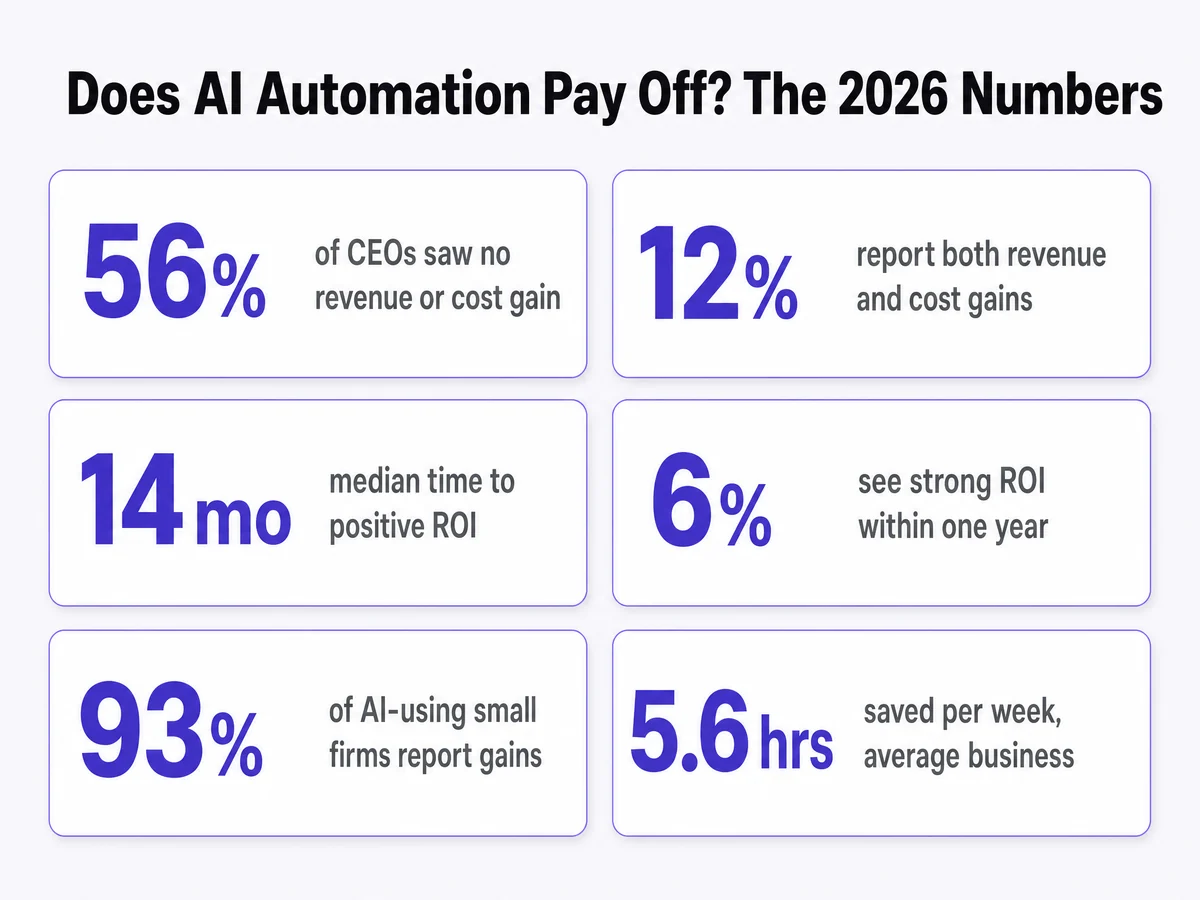
- PwC’s 2026 CEO Survey found 56% of CEOs saw neither higher revenue nor lower costs from AI in the previous 12 months; only 12% reported both.
- Goldman Sachs found the small-business picture far sunnier: 93% of AI-using owners report a positive impact and 84% cite efficiency gains (1,256 owners, February 2026).
- Those two findings are not contradictory. They measure different things — enterprise programmes versus a couple of narrow small-business workflows.
- IDC puts the median time to positive ROI at about 14 months; Deloitte found only 6% of organisations reached satisfactory ROI on a typical use case inside a year.
- Vendor payback claims of two to four months come overwhelmingly from vendors, measured on their own surviving customers.
- The average small business saves about 5.6 hours a week with AI — which is only money if those hours get redeployed.
- The single biggest predictor of a negative return is automating a process nobody has written down.
Ask this question online and you get two answers, both delivered with total confidence. Vendors say payback in two months. Headlines say 95% of pilots fail, citing MIT. Both are quoting real research.
They disagree because they are answering different questions. (If you are still at the definitional stage, start with what is AI automation.) Untangling that is most of the work, so this article does it first, then gives you the arithmetic to answer the question for your own business.
What Does “Worth It” Actually Mean Here?
“Return” gets used for three different things, and most of the argument online comes from people comparing one to another without noticing.
| What gets counted | What it actually is | Shows up in the P&L? |
|---|---|---|
| Recovered revenue | Work you would have lost — a missed call that books instead | Yes, directly |
| Cash cost removed | A service, subscription or contractor you stop paying | Yes, directly |
| Labour-equivalent value | Hours freed, valued at an hourly rate | Only if those hours are redeployed |
The third row is where most published ROI figures live, and it is the one that quietly does not count. Five hours a week returned to an owner who uses them to sell is worth real money. The same five hours returned to a salaried employee who absorbs the slack is a genuine improvement in working life that will never appear in your accounts.
This is not an argument against automating. It is an argument for being honest about which of the three you are buying, because only two of them pay a bill.
What Do the AI Automation ROI Numbers Actually Say?
Taken together, the 2026 evidence is unusually consistent about one thing: the distribution is bimodal. A minority do very well and a majority get little.
On the pessimistic side, PwC’s 2026 CEO Survey found 56% of chief executives reported neither increased revenue nor decreased costs from AI over the previous year, with just 12% reporting both. MIT’s NANDA initiative found roughly 95% of generative AI pilots showed no measurable P&L impact within about six months. Deloitte, in October 2025, found only 6% of organisations reported satisfactory ROI on a typical AI use case in under a year.
On the optimistic side, Goldman Sachs’ 10,000 Small Businesses Voices survey of 1,256 owners in February 2026 found 93% of AI users reporting a positive impact, 84% citing efficiency and productivity, and 67% expecting AI to increase revenue.
Both are credible. The reconciliation is in the next section.
Why Do Vendor Payback Claims and Independent Studies Disagree?
Four reasons, and once you see them the gap stops being mysterious.
1. Different units of analysis. Independent studies measure an organisation’s entire AI programme. Vendor case studies measure one workflow. A single missed-call automation can pay back in weeks while the same company’s broader AI spending shows nothing.
2. Survivorship. Vendor ROI figures are drawn from customers who stayed. The businesses that bought, struggled and cancelled are not in the sample. S&P Global found 42% of companies abandoned most of their AI initiatives in 2025, up from 17% the year before — that churn is exactly the population missing from vendor averages.
3. Different definitions of return. Most vendor ROI is labour-equivalent value. Most independent research looks for margin or revenue movement. Same deployment, two very different numbers.
Terminology does the same work. A product sold as an agent and a product sold as an automation can be the same thing at very different prices — see AI agent vs automation for the test that separates them.
4. Scope and complexity. Enterprise AI programmes carry integration, governance and change-management costs a six-person business simply does not have. Small businesses have a genuine structural advantage here, and it is the main reason the Goldman Sachs figures look nothing like the PwC ones.
Small businesses do not want to have an automation platform at all, they want a system that keeps on running by itself. The actual product is not the workflow but rather the ability to continue maintaining it even when its creator is no longer around.
— r/automationWhen Is AI Automation Worth It?
From what we see survive in production, the positive cases share five features. The more of them a job has, the safer the business case.
- The job touches revenue directly. Missed calls, first response to an enquiry, quote follow-up. Each recovered instance has a dollar value you already know, which makes the maths arguable rather than theoretical — AI lead generation is the clearest case.
- Volume is high enough to matter. A task worth three minutes, done 200 times a month, is 120 hours a year. Frequency beats drama.
- The process is already written down. If you can describe it on one page, it can be automated. If you cannot, you have a documentation job first.
- Exceptions are rare. Once more than roughly a third of cases need a human decision, staff route around the system and you are paying for something nobody uses.
- Somebody owns it after launch. A named person who checks the exception queue. Without this the return decays quietly — see who maintains my AI automation after it’s built.
For the job-by-job version of this, see what you can actually automate in your business with AI, and for the shortlist aimed at BC operators, 5 AI automations every BC business should use.
When Is AI Automation Not Worth It?
Saying no is the more valuable half of this article, because the failure modes are predictable.
- You are buying a programme, not a job. “We should do AI” is not a business case. It is the exact posture the MIT research found produced nothing measurable.
- The volume is not there. Automating something that happens twice a month will cost more in attention than it returns, permanently.
- The work needs judgment. Pricing, negotiation and complaint handling are not automation candidates; they are the reason customers pay you.
- The process only exists in someone’s head. Automating an undocumented process scales its inconsistencies at machine speed.
- Nobody will own it. If you cannot name the person before launch, the honest projection is that it degrades within a year.
- You need the freed hours to become cash but cannot redeploy them. Be clear with yourself about this one before you sign anything.
How Do You Work Out Your Own Payback?
The arithmetic is deliberately simple, and it uses net rather than gross benefit:
Payback in months = setup cost ÷ (monthly benefit − monthly running cost)
A worked example, using round illustrative numbers rather than a client’s actual figures. Suppose a trades business misses six calls a week and is considering an AI receptionist to catch them. Say one in five of those would have become a job worth $400. That is six calls × 0.2 × $400 = $480 a week, or roughly $2,080 a month in recovered work. If the system costs $300 a month to run, net monthly benefit is $1,780. At a $2,500 setup, payback lands at about 1.4 months.
Now change one input. If only one in twenty missed calls would have converted, the monthly benefit falls to about $520, net benefit to $220, and payback stretches past eleven months. Same technology, same vendor, entirely different decision.
Two inputs do all the work here: how often the job happens, and what one instance is worth. Ranking your own candidates on exactly those inputs is covered in how do I know what to automate first. Neither is a technology question. For real pricing bands, see what AI automation costs a small business, and if you are weighing this against a hire, AI automation vs hiring covers that comparison.
How We Sourced This
Three inputs. Our own production data — Avelle builds and maintains AI voice, chat and booking systems for clinics, trades and multi-location retail in British Columbia. Practitioner discussion from Reddit threads mined in September 2026, where operators describe what broke rather than what launched. Published survey data from PwC, Goldman Sachs, IDC, Deloitte, S&P Global and MIT’s NANDA initiative.
Figures come from publisher releases and published coverage rather than re-analysis of underlying datasets; the S&P Global and IDC reports sit behind paywalls and are cited via secondary coverage. The IDC return figure was produced in research sponsored by Microsoft, which is worth knowing when weighing it. The worked example above uses illustrative round numbers, not a client’s books. Where we could not source a number, we left the claim out.
Worth reading alongside this: whether AI could really do half your job. Most businesses already save hours they never reassign, which is where the return quietly disappears.
Frequently Asked Questions
It can be, but the threshold is volume rather than headcount. If a repeat task happens dozens of times a week, a two-person business clears the bar. If your enquiry volume is a handful a week, the running cost will outrun the return and the honest answer is not yet.
For a single revenue-linked job such as missed-call capture, small businesses commonly see payback inside a few months. Independent research is far more conservative across all AI spending: IDC puts the median time to positive ROI at about 14 months, and Deloitte found only 6% of organisations reached satisfactory ROI on a typical use case within a year.
Three reasons: vendor samples are drawn from their own surviving customers, vendor ROI usually counts labour-equivalent value rather than cash, and vendor case studies describe one narrow workflow while independent studies measure entire AI programmes.
Only if the freed hours get redeployed. Five hours a week returned to an owner who then sells more is worth real money. Five hours returned to a salaried employee who absorbs the slack is a genuine quality-of-life gain but does not appear in the P&L.
For a single narrow job, expect a one-time setup plus a modest monthly running cost. The number that actually decides total cost is maintenance after launch rather than the build. Tool options are compared in the best AI automation tools for Canadian small business.
When the process is not written down, when volume is low, when more than roughly a third of cases need human judgment, or when nobody is named to own it after launch. Any one of those turns a positive-looking business case negative.
MIT's researchers found the minority of successful deployments tended to buy rather than build and to target unglamorous back-office friction. For a business under 50 staff without in-house engineering, buying and owning the outcome usually beats building and owning the code — we argue both sides in can I build my own AI automation.
Want the Payback Run on Your Numbers?
Book a free 30-minute call. We will take your two or three most repetitive jobs, put real volumes and values against them, and tell you plainly which ones clear the bar — including when the answer is none of them.
Book Your Free AI Assessment →