
Key Takeaways
- The dividing line is decision-making, not intelligence. Automation executes a sequence you specified; an agent selects a sequence you did not.
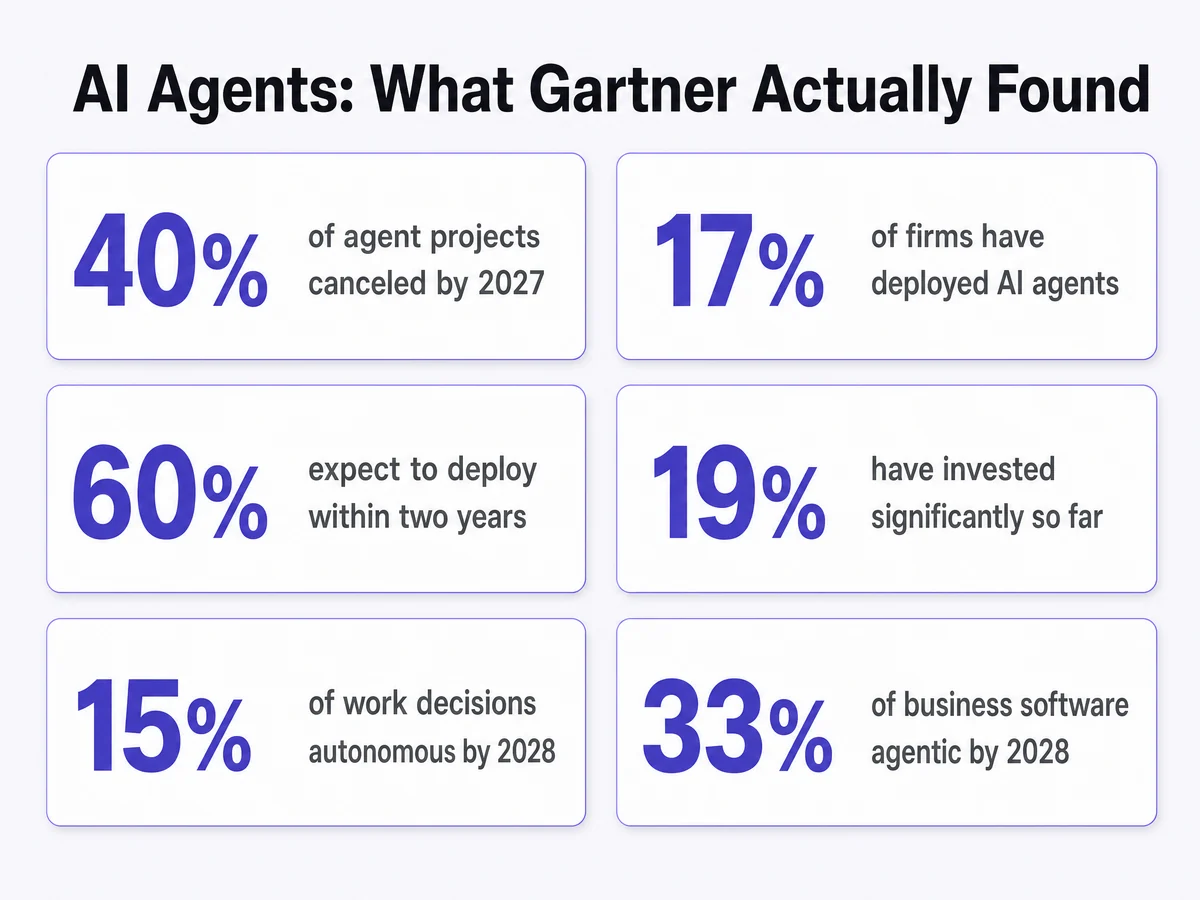
- Gartner predicts over 40% of agentic AI projects will be canceled by the end of 2027, citing escalating costs, unclear business value and inadequate risk controls.
- Gartner puts deployment at 17% of organisations while more than 60% expect to deploy within two years — expectation is running a long way ahead of practice.
- Gartner names “agent washing” — rebranding chatbots and rule-based tools as agents — as one driver of those cancellations.
- Agents fail differently from automation: automation breaks loudly, an agent produces a confident wrong answer that can go unnoticed for weeks.
- Cost profiles differ too. Automation has a near-zero, predictable marginal cost; an agent reasons on every case and bills for it.
- The practical test: if a vendor can draw you the flowchart, you are buying automation. That is usually the right purchase.
This distinction has become genuinely hard to pin down, because the word “agent” is now attached to almost everything: copilots inside apps, chat widgets, scheduled scripts with a language model bolted on. Gartner has a name for it, which we will get to.
The useful version of the answer is not a taxonomy. It is a test you can run on whatever you are being sold.
What Is Automation?
Automation executes a sequence somebody defined in advance. A form is submitted, so a record is created, so an email goes out, so a task appears in someone's queue. The path is fixed. Given the same input, it does the same thing today, next Tuesday and next year.
Modern automation can include AI without becoming an agent. A workflow that calls a language model to summarise an email and then always files that summary in the same place is still automation — the model made the text, but the sequence was yours. This is what AI automation means in practice, and it is what most business software described as “AI-powered” actually is.
Its strengths are unglamorous and considerable: it is cheap per run, predictable, easy to audit, and when it breaks it usually breaks in an obvious way.
What Is an AI Agent?
An AI agent is given a goal rather than a sequence, and works out the route itself. It can decide the order of steps, choose which tools to call, react to what it finds partway through, and decide it is finished. Two runs of the same agent on similar inputs can legitimately take different paths.
The step beyond that is agentic AI: several agents plus tools and data sources coordinating across a longer workflow. A single agent handles one well-defined task; an agentic system strings many together.
That flexibility is the whole point, and it is also the whole risk. A system that can choose its own path can choose a path you did not anticipate.
How Does an AI Agent Compare to Automation?
Seven differences that actually change a buying decision.
| Automation | AI agent | |
|---|---|---|
| Who decides the sequence | You, in advance | The system, per case |
| Input it handles well | Structured and predictable | Messy and variable |
| On an unexpected case | Stops, errors or routes to a human | Decides, retries, or escalates on its own |
| How you change its behaviour | Edit the flow | Change the goal or the guardrails |
| Marginal cost per run | Near zero, fixed | Variable, priced per reasoning step |
| How it fails | Loudly — it stops | Quietly — it is confidently wrong |
| Best fit | High volume, same shape every time | Lower volume, high genuine variety |
The row that matters most for a small business is the second from bottom. Automation failing is an inconvenience you notice the same day. An agent failing is a plausible-looking wrong answer sent to a customer, and you may find out a month later.
Why Does the Difference Matter for Your Business?
Because you are probably being quoted for one and sold the other, and the pricing is not the same.
Gartner's forecast that over 40% of agentic AI projects will be canceled by the end of 2027 is not a claim that the technology fails. The reasons given are escalating costs, unclear business value and inadequate risk controls — management problems, not model problems. Senior Director Analyst Anushree Verma described most current agentic projects as early stage experiments or proofs of concept driven by hype and often misapplied.
That maps almost exactly onto what MIT's NANDA initiative found across generative AI more broadly, and onto the S&P Global abandonment figures we covered in is AI automation worth it for small business. The pattern repeats: capability is not the constraint, scoping is.
One date correction worth having, since a lot of coverage gets it wrong: that Gartner prediction was published in June 2025 and resurfaced in mid-2026. It is frequently reported as new. It is not.
How Can You Tell If You Are Being Sold Agent Washing?
Gartner's term for relabelling existing chatbots, assistants and rule-based workflows as agents without changing what they do. Three questions settle it, and any vendor who genuinely built an agent will enjoy answering them.
- Can it take a different route next time, without anyone editing it? If every path was drawn by a human in advance, it is automation. Useful automation, but automation.
- Can it decide on its own to stop, retry or escalate? Not “does it have an error branch you configured” — can it make that call itself, on a case nobody anticipated?
- Was it given a goal, or a script? Ask what the system is optimising for. If the answer describes steps rather than an outcome, you have your answer.
Most products marketed as agents sit in the second band. That is not fraud and it is not useless — band two is where the majority of genuinely valuable small-business work happens. It is only a problem when it is priced as band three.
When Do You Need an Agent, and When Is Automation Enough?
Automation is enough when the task has the same shape every time, volume is high, the steps can be written on one page, and a wrong answer is expensive. That covers most of what a business under 50 staff should be automating — the jobs listed in what you can actually automate with AI: repeat questions, missed calls, booking, reminders, follow-up, data entry. An AI receptionist that answers, qualifies and books is doing a bounded job extremely well, and it does not need to be an agent to do it.
An agent starts to earn its keep when cases are genuinely varied rather than merely numerous, when the number of branches would be unmanageable to draw, when a human currently exercises judgment you can describe as a goal, and critically when being wrong occasionally is survivable.
Research triage, drafting a first-pass reply to an unusual enquiry, reconciling messy records that never arrive in the same format — these are agent-shaped. Sending an appointment reminder is not, and never will be.
If you are not sure which category your work falls into, the scoring sheet in how do I know what to automate first sorts it: anything scoring high on consistency is automation work by definition.
How We Sourced This
Our own production data. Avelle builds and maintains AI voice, chat and booking systems for clinics, trades and multi-location retail in British Columbia. Almost all of it is band-one and band-two work, which is itself a finding.
Gartner's published research on agentic AI cancellations, deployment rates and agent washing, cited inline with the original June 2025 press release rather than the 2026 re-coverage. Practitioner discussion from r/automation, mined September 2026, where the recurring complaint is maintenance rather than capability.
Figures come from publisher releases and published coverage rather than re-analysis of underlying datasets. Gartner's investment-posture percentages come from a January 2025 poll of 3,412 webinar attendees, which is a self-selecting sample and should be read as directional. Where we could not source a number, we left the claim out. Related reading: generative AI use cases, workflow automation, and who maintains my AI automation after it's built.
Frequently Asked Questions
Who decides the next step. Automation runs a sequence you defined in advance and does the same thing every time. An AI agent is given a goal and works out its own route to it, which means it can take a different path on a case it has not seen before.
No, though a lot of what is marketed as an agent genuinely is. The real distinction is whether the system can choose a sequence you did not specify. If every path it can take was drawn by a human in advance, it is automation with a language model attached to the front.
Almost certainly automation, at least first. Agents earn their keep where cases are genuinely variable and the cost of a wrong turn is low. Most small-business work that is worth automating is repetitive and consistent, which is exactly what automation is better and cheaper at.
Relabelling an existing chatbot, assistant or rule-based workflow as an AI agent without changing what it does. Gartner names it as a driver of agentic project cancellations, and it is common enough that it is worth testing any agent claim before you buy.
Generally yes, per run and to operate. Automation has a near-zero and predictable marginal cost, while an agent reasons on every case and bills accordingly. Agents also need more supervision, because they fail in less obvious ways.
Automation, for anything with a fixed shape. It does the same thing every time, and when it breaks it usually breaks loudly. An agent handles novelty better but can produce a confident wrong answer that nobody notices for weeks.
A single agent handles one well-defined task. Agentic AI describes a system coordinating several agents, tools and data sources across a longer multi-step workflow. The step up in capability comes with a matching step up in supervision and cost.
Not Sure Whether You Need an Agent or an Automation?
Book a free 30-minute call. We will look at the actual job, tell you which band it falls into, and quote it accordingly — including when the honest answer is the cheaper one.
Book Your Free AI Assessment →