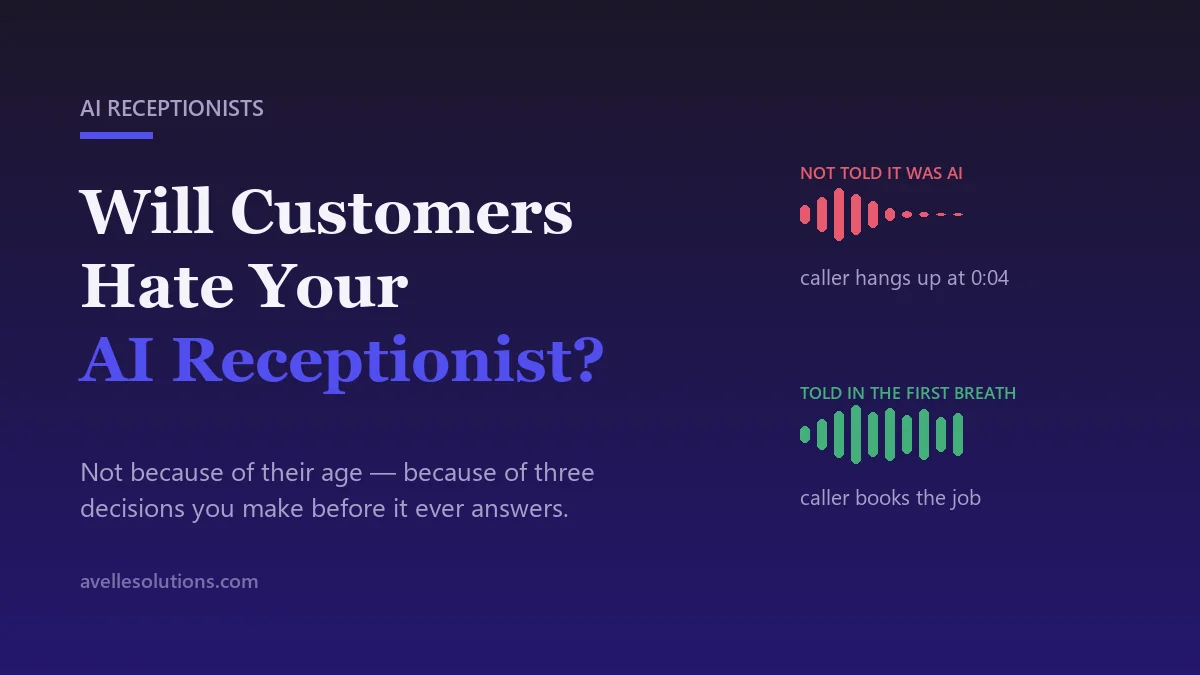
Will customers hate your AI receptionist?
Some of them will. Roughly one in three say they would hang up rather than speak to an AI. But the surveys and the operators agree on something more useful than that headline: what callers object to is an AI that hides what it is, cannot finish the job, or will not let them reach a person. Fix those three things and most callers stop caring.
The comparison that decides this is also not the one most owners run in their heads. You are not choosing between an AI receptionist and a receptionist. If you were, this would be an easy article. You are almost always choosing between an AI receptionist and nobody — voicemail at 7pm, a ring-out while you are under a sink, a missed call during a client appointment. That is why the question deserves taking seriously in both directions, and why the honest answer depends on how the thing is built rather than whether it exists.
If you want the product and pricing picture first, start with our honest review of AI receptionists for small business in Canada, then come back here before you launch one.
What does the survey data actually say — and who paid for it?
Almost every page ranking for this question was published by a company selling one side of the answer. So here is the evidence with the commissioning party named beside it, which is the only honest way to read it. Every consumer figure below is North American, and every current figure is from 2026 fieldwork — older numbers appear only where they are useful as a trend line, and are labelled as such.
| Source | Sample, geography and fieldwork | Finding | Whose interest |
|---|---|---|---|
| Gartner | 3,566 B2B and B2C customers, February–March 2026 | 87% say it is essential that a company using GenAI still offers the option to reach a human agent. Asked what would change their mind, customers unwilling to engage with AI most often named the ability to switch to a human. 58% of GenAI users have used it to complete a task, not just get an answer (74% in B2B) | Independent analyst firm — no stake either way |
| AnswerConnect / OnePoll | 6,000 consumers, US, UK and Canada, April 2026 | 31% would hang up if connected to AI (29% in the October 2025 wave); 38% unsure or “it depends”; 85% prefer a real person; 86% say companies should clearly state when AI is used | Sells human-staffed answering |
| Moneypenny / Censuswide | 2,000 US consumers and 2,000 US business decision makers, 17 March – 3 April 2026 | On AI receptionists, 50% of businesses believed they were delivering well; only 26% of consumers agreed | Sells human-staffed answering |
| Statistics Canada | 9,251 responding Canadian businesses from a 21,105 sample, fieldwork 1 April – 6 May 2026 | 19.2% of Canadian businesses used AI to produce goods or deliver services in the prior 12 months — up from 12.2% in Q2 2025 and 6.1% in Q2 2024. 40.0% say AI is not relevant to their business | National statistical agency — no commercial stake |
| Gartner (historical comparison) | 5,728 customers, fieldwork December 2023, published July 2024 | 64% would prefer companies did not use AI for customer service; 53% would consider switching over it; 60% worried AI would make it harder to reach a human | Independent — used here only as a trend baseline |
| AI vendor call analysis | 1,446,980 calls across 2,074 businesses; vendor does not publish fieldwork dates or geography | 99% of callers expressed positive or neutral sentiment | Sells AI receptionists |
That last row deserves a paragraph, because it is the figure the AI industry quotes most and it cannot answer the question being asked of it. It measures sentiment on calls that happened. The people this article is about — the ones who hang up at second four — are by definition not in the sample, and a silent hang-up never registers as negative sentiment. The number is probably true and almost entirely beside the point. The two answering services have the mirror-image problem: a company whose product is human receptionists is not a neutral party on whether people hate robot ones.
Strip the incentives out and three findings survive.
The objection is being trapped, not the AI itself. This is the most robust finding in the current data. In Gartner's February–March 2026 survey, 87% said it is essential that a company using GenAI still offers a route to a human agent — and when Gartner asked the customers who refuse to engage with AI at all what would change their minds, the most common answer was simply being able to switch to a human. The concern has hardened rather than faded: in Gartner's December 2023 fieldwork, 60% worried AI would make reaching a human harder. Two and a half years later it is close to universal. That is a design complaint, and design complaints are fixable.
Disclosure has broader support than AI has opposition. 86% want to be told when AI is in use — a larger share than say they dislike AI at all. Plenty of people perfectly comfortable with an automated assistant still want it announced.
Owners systematically overrate how well theirs is landing. The Moneypenny gap — 50% of businesses versus 26% of consumers — is the single most useful statistic here. If you already run an AI receptionist and have never listened to a recording of it failing, assume you are in the 50%.
One piece of Canadian context worth holding alongside all of this, because it sets the odds your callers have met one of these before. Statistics Canada's Canadian Survey on Business Conditions found 19.2% of Canadian businesses used AI to produce goods or deliver services in the year to Q2 2026 — up from 12.2% a year earlier and 6.1% in Q2 2024. Adoption roughly tripled in two years, and US Census figures over a comparable window put American businesses at a similar level. Your customers are no longer encountering this for the first time on your line, which cuts both ways: the novelty objection is fading, and so is their patience for a bad one.
The number nobody quotes: alongside the 31% who would hang up sit 38% who said they were unsure, or that it depends. Neither camp has any incentive to talk about that group. They are the largest share of your callers, and they are the ones your build decides.
Is it true that older customers hate AI receptionists?
The version of this question owners usually ask is whether an AI receptionist will annoy their older customers. It is the wrong axis, and the operators running these systems say so with unusual consistency.
In a 56-comment r/smallbusiness thread asking home service owners exactly this, the most detailed reply from someone who had actually run one reported the opposite of the expectation. The callers it upset were not the older ones but people in their mid-thirties, who realised mid-sentence that the human name they were talking to was a machine. Older callers, they said, treated it like an answering machine that talks back — a technology they have been comfortable with since the 1980s. Complaints stopped once the system announced it was automated in the first breath. Their summary is the thesis of this article: people forgive a robot for being a robot; they do not forgive it for pretending.
A second operator in the same thread drew the other line that matters — whether the system can actually book the job or only take a message. If it books, callers mostly do not care what answered, because something happened. If it says “someone will call you back,” they feel they got a machine instead of service, and that is equally true at 25 and at 65.
Honesty about a source cuts both ways, so: the most upvoted comments in that thread were flatly hostile. “AI receptionists — the best way of letting your prospects know you don't care” drew 43 votes; “they piss off all ages of customers” drew 30. In a parallel 62-comment thread, the top reply was a blunt refusal to do business with any company that answers with a bot.
Both things sit in the same data, and the asymmetry is informative rather than contradictory. The hostile comments come overwhelmingly from people describing AI systems they have called. The conditional ones come from people describing systems they have run and measured. They are answering slightly different questions, and only the second group can tell you which build decisions moved the outcome.
Decision 1: Does it say it's AI in the first sentence?
This is the cheapest fix available and the one most commonly skipped, because disclosure feels like an admission. It is not. It is the thing 86% of consumers said they wanted.
The failure mode is specific: a human first name, a convincingly human voice, no qualifier. The caller spends thirty seconds believing they are talking to a person — explaining a problem, using the small courtesies people use with other people — and then works it out. The injury is not that they reached an AI. It is retroactive. They feel they were fooled, and everything they just said feels wasted.
“Hi, you've reached Northshore Plumbing. I'm an automated assistant — I can book you in right now, or get a message straight to Dave. This call is recorded.”
“Hi, this is Jessica! How can I help you today?” — a human name, a synthesised voice, no qualifier, and disclosure only if the caller thinks to ask.
One sentence, at the front, with no apology in it. It costs about two seconds and removes an entire category of complaint. If you want a human name for warmth, keep it — just put “automated assistant” in the same breath.
The Canadian angle. There is currently no Canada-wide statute specifically requiring you to tell a caller they are speaking with an AI on a service line. Privacy law pushes the same way regardless: if you record or transcribe calls — and an AI receptionist does — PIPEDA and its provincial equivalents require you to explain the purpose and obtain meaningful consent, and the Office of the Privacy Commissioner publishes specific guidance on recording customer telephone calls. Since you already owe the caller a recording notice, the AI disclosure costs nothing extra to include. This is general information rather than legal advice; if transcripts feed anything beyond call handling, say so explicitly and check it with counsel.
Decision 2: Can it finish the job, or does it just take a message?
A system that answers, gathers details and promises a callback is a talking voicemail with extra steps. Callers grade it as one. The moment an AI receptionist becomes worth having is the moment it can see your calendar and put someone in it while they are still on the line.
The 2026 Gartner data says the same thing about AI generally: 58% of people who use generative AI have used it to complete a task on their behalf rather than just to get an answer, rising to 74% in business settings. Gartner's own read is that most company-provided bots are still built to answer questions while customers have moved on to expecting action — booking an appointment, submitting something, changing an account. An AI receptionist that only relays messages is on the wrong side of that shift.
This is also the one place an AI receptionist beats a human answering service outright, because most answering services cannot see your calendar either — the point we make at length in AI receptionist vs answering service. Booking is what turns the call from an obstacle into an outcome, and an outcome is what stops people caring who delivered it.
There is one failure worse than taking a message, and it is worth naming because it produces genuinely angry customers rather than mildly irritated ones: promising something the business cannot honour. One caller in the threads above described being given a two-hour arrival window by a system they had not been told was automated, cancelling their plans for the day, and having nobody turn up. The AI did not malfunction. It did exactly what it was configured to do — somebody had let it commit to a slot it had no authority to commit to.
The rule is narrow and belongs in the build spec: an AI receptionist may only commit to things that are true in your calendar at the moment it says them. Real slot, real hold, real confirmation. Anything softer is a message, and it should be phrased as one.
Decision 3: Can the caller reach a human?
This is the one the current data is loudest about. In Gartner's February–March 2026 survey of 3,566 customers, 87% said it is essential that a company using AI still offers a way through to a human agent — and the customers who refuse to deal with AI at all told Gartner that the single thing most likely to change their mind was being able to switch to a person. The dominant fear is not the machine. It is the machine as a wall.
Three things make the escape hatch real rather than decorative.
It works on plain language. “Let me talk to someone,” “is there a person there,” and an exasperated “representative” all have to work. If your system responds to only one magic phrase, it is a wall with a door painted on it.
It triggers on its own. Repetition, rising frustration, or two consecutive comprehension failures should escalate without the caller having to ask. Callers who have to fight their way out remember the fight.
It is honest when there is nobody there. This is the part most builds get wrong. At 11pm there is no human to transfer to, and pretending otherwise — a hold tone, a queue, a transfer that dead-ends — is worse than the truth. “Dave is off the tools until 7am. I've logged this as urgent, he sees it first thing, and I'm texting you a confirmation now” outperforms a fake transfer, because it is a real answer.
And do not put a menu tree in front of any of it. “Press 1 for sales” is the experience people are usually describing when they say they hate AI receptionists. Most of what gets blamed on AI was invented by touch-tone phone systems decades before AI could speak.
What does caller drop-off actually cost you?
The three decisions above move one number: the share of callers who hang up rather than engage. Here is what each point of that number is worth in your business.
📞 Drop-off cost estimator
The 31% default is the share of consumers who told a survey they would hang up on an AI — research commissioned by a company selling human answering, so treat it as a worst case rather than a measured rate for your line. The point of this tool is the third card: it tells you what the three build decisions above are worth before you decide how much care they deserve.
Which calls should an AI receptionist never take?
Some of the hostility in the survey data is earned, and pointing an AI receptionist at the wrong calls is how you earn it. Four categories should route to a person or to voicemail, not to a bot.
Emotionally heavy calls. Bereavement, a health scare, a complaint about harm your business caused, a cancellation from someone already angry. Gartner's respondents rated humans higher on empathy for good reason, and the cost of mishandling one of these is not a lost booking. It is a review and a story.
Judgement calls that belong to you. Quoting a non-standard job, negotiating price, waiving a fee, promising an arrival time. If a decision would make you pause, it should make the AI stop.
Vague diagnostic calls. Operators are consistently counter-intuitive here: the 2am burst pipe is the easy case, because that caller knows exactly what they want and will talk to a toaster to get someone dispatched. The call that defeats a bot is “my furnace is making a noise, is that bad?” — where a human would ask two quick questions and the bot flails. Our guide to AI receptionists for trades covers where those triage lines belong.
Almost none of your calls. If you are genuinely missing only a handful of calls a month, this is a solution to a problem you do not have, and no amount of good build decisions changes that. Pull last month's call log, count the calls under ten seconds, and multiply by your average job value before you buy anything. If that number is small, we would rather tell you now.
Methodology and what we excluded
The standard we held this to. Every consumer statistic above comes from a US or Canadian sample, and every figure carrying an argument comes from 2026 fieldwork. Where an older number appears it is there as a trend line and is labelled with its fieldwork date, never presented as the current picture — the December 2023 Gartner wave is used that way once, to show that the demand for a route to a human has hardened rather than softened.
Every statistic links to its primary source and is labelled with who commissioned it, because on this particular question the commissioning party predicts the finding with uncomfortable accuracy. Gartner's current figures come from a survey of 3,566 B2B and B2C customers conducted in February and March 2026, with a companion survey of 1,303 senior leaders between January and April 2026. AnswerConnect's come from OnePoll surveys of 6,000 US, UK and Canadian consumers in October 2025 and again in April 2026. Moneypenny's come from Censuswide fieldwork with 2,000 US consumers and 2,000 US business decision makers between 17 March and 3 April 2026. The Canadian adoption figures are from Statistics Canada's Canadian Survey on Business Conditions, collected 1 April to 6 May 2026 from 9,251 responding businesses drawn from a stratified sample of 21,105.
Practitioner sentiment is drawn from two public r/smallbusiness threads with 118 comments between them, read in full rather than sampled from titles. They are anonymous and self-selected, and are used for pattern only — never as evidence for a number.
We excluded a figure we wanted to use. A widely repeated statistic holds that 59% of consumers are comfortable with an AI answering promptly, rising to 68% once they know they can reach a real person, usually attributed to a Moneypenny survey of 5,001 UK consumers. It is precisely the shape of evidence this article's argument wants, which is exactly why it deserved checking. We could not trace it to a primary Moneypenny release, so it is not used here, and nothing above depends on it.
We also excluded the vendor-published missed-call statistics that appear on nearly every competing page — “62% of calls to small businesses go unanswered,” “$200+ in lost lifetime value per missed call.” They may well be directionally right. None carries a traceable methodology, and all are published by companies selling the fix.
What this means for your business
If you take one thing from the data, make it the Moneypenny gap: half of businesses think their AI receptionist is landing well, and a quarter of consumers agree with them. The distance between those two numbers is made up almost entirely of owners who have never listened to their own system fail.
So before you buy, or if you already run one: pull ten recordings and listen for the three things. Does it say it is automated in the first sentence? Does it book, or does it promise a callback? What happens when the caller asks for a person — and what happens at 11pm when there is not one?
If it fails any of the three, that is a build problem, and build problems are fixable without changing vendors. Worth reading before you launch: who maintains it after it is built, because an AI receptionist that drifts out of date is a system confidently telling your customers things that stopped being true.
Frequently Asked Questions
Some will. In a OnePoll survey of 6,000 consumers across the US, UK and Canada commissioned by AnswerConnect in April 2026, 31% said they would hang up if connected to an AI, up from 29% six months earlier, with a further 38% saying they were unsure or that it depends. That 38% is the group your build decides. AnswerConnect sells human-staffed answering, so read the figure as a worst case rather than a measured drop-off rate for your line.
There is currently no Canada-wide statute that specifically requires disclosing that a caller is speaking to an AI on a customer service line. Privacy law pushes hard in that direction anyway: if you record or transcribe calls, PIPEDA and its provincial equivalents require you to explain the purpose and obtain meaningful consent, and the Office of the Privacy Commissioner publishes specific guidance on recording customer telephone calls. In practice the AI disclosure and the recording notice belong in the same opening sentence. This is general information, not legal advice.
The evidence does not support that. Operators running these systems consistently report that age is not the dividing line. Several describe older callers treating an AI receptionist like an answering machine that talks back, while callers in their thirties reacted worst on realising mid-conversation that a human-sounding voice was automated. The variable is disclosure, not demographics.
For a business that is genuinely missing calls, usually yes, because the honest comparison is not AI versus a receptionist. It is AI versus nobody. A caller who reaches voicemail at 9pm mostly does not leave a message; they call the next business. An AI receptionist that discloses itself and books the job converts that call. One that only takes a message is a talking voicemail, and callers grade it as exactly that.
Giving it a human first name and no disclosure. The damage is not that the caller reached an AI. It is the retroactive sense of having been fooled once they work it out. In the same OnePoll research, 86% of consumers said companies should clearly state when AI is being used, a higher share than say they dislike AI at all. Even people comfortable with AI want to be told.
Only alongside an explicit statement that it is automated. A name on its own invites the caller to assume a person, and that assumption is what later feels like a deception. Adding “I'm an automated assistant” to the opening sentence costs about two seconds and removes the entire objection.
They should be able to, and building it that way addresses the strongest finding in the current data. In Gartner's survey of 3,566 B2B and B2C customers conducted in February and March 2026, 87% said it is essential that a company using generative AI still offers the option to reach a human agent, and customers unwilling to engage with AI at all most often named the ability to switch to a human as the thing that would change their mind. The escape hatch needs to work on a plain-language request, trigger automatically on frustration, and be honest when no human is available rather than transferring the caller into a dead queue.
Get a Second Pair of Ears on Your Call Flow
We build AI voice, chat and booking systems for BC clinics, trades and multi-location retail — every one discloses itself, books into a real calendar, and hands off to a human on request. And we will tell you if your call volume does not justify one.
Book Your Free AI Assessment →