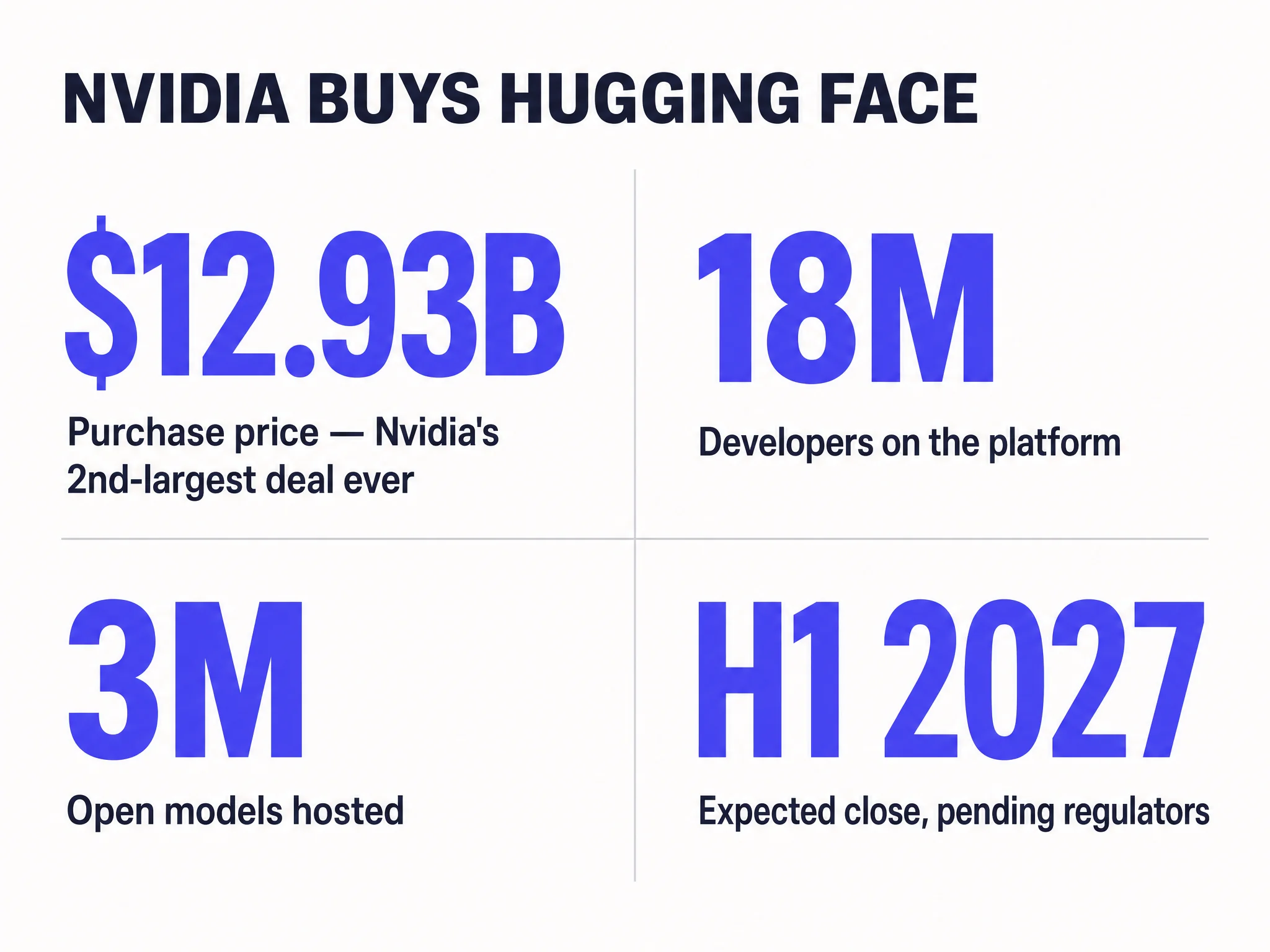
- $12,930,300,000 — roughly $11.9B to stockholders plus up to $1B in equity retention (Nvidia SEC 8-K).
- Nvidia’s second-largest acquisition ever, behind its ~$20B purchase of Groq assets.
- Hugging Face hosts 3 million models for 18 million developers and 200,000+ companies.
- Jensen Huang committed in writing that “NVIDIA compute will not be required” to build or deploy on the platform.
- The real test is Optimum — four of its five backend packages exist to make AMD, Intel, AWS and Google silicon easy to use. Nvidia will now fund them.
- Closing is expected in H1 2027, subject to mandatory US and EU merger review.
Nvidia is buying Hugging Face for $12,930,300,000, and it made an unusually specific promise while doing it. Writing on the company blog, Jensen Huang said developers “will choose the models they want, the frameworks they want, the clouds and inference service providers they want and the computing platforms they want” — and that “NVIDIA compute will not be required to build on or deploy through Hugging Face.”
I believe he means it. I also think it’s beside the point. What Nvidia bought here isn’t just a model registry — it’s a payroll. Hugging Face employs the engineers whose job is making Nvidia’s competitors easy to use.
What exactly did Nvidia buy in the Hugging Face acquisition?
Nvidia signed the definitive agreement on 2 September 2026 and announced it the following day. Per the company’s 8-K filing, roughly $11.9 billion goes to Hugging Face stockholders, with up to about $1 billion more in equity retention for employees joining Nvidia.
It is the second-largest acquisition in Nvidia’s history — behind its roughly $20 billion purchase of Groq assets, and well ahead of the $7 billion Mellanox deal in 2019. Closing is expected in the first half of 2027, subject to regulatory approval.
Why does the Nvidia Hugging Face acquisition matter?
Because of what Hugging Face is. More than 18 million developers, researchers and creators share over 3 million models, 500,000 datasets and 1 million applications on the platform, and more than 200,000 companies use it to discover, evaluate, customise and deploy AI.
That makes it the default front door to open AI — the layer that decides which models get found. Nvidia already controls the compute layer underneath. Buying the discovery layer on top is textbook vertical integration, and it cost roughly a quarter of one percent of Nvidia’s market capitalisation.
This is a genuinely open ecosystem question, not just a business story. If you want the background on why open models matter to smaller companies at all, our explainer on what AI automation actually is covers the layers underneath most business tools.
What did Nvidia promise about Hugging Face staying open?
More than most acquirers do. Huang committed in writing to multi-cloud and multi-accelerator support, and explicitly said Nvidia hardware would not be required. He also framed the rationale around access rather than lock-in.
Open models let startups, businesses, universities and public institutions build on advanced capabilities without training every model from scratch. They enable organizations to match the right model to the right job.
— Jensen Huang, Founder & CEO, NVIDIAWorth noting: Nvidia isn’t an outsider occupying a platform it never used. It has already published more than 500 models and 250 open datasets on the Hub, and it invested in Hugging Face’s $235 million round back in 2023. This is a deepening relationship, not a hostile takeover.
Why the Optimum libraries are the real test
Here is the part almost nobody is covering. Hugging Face maintains a library family called Optimum, and its entire purpose is making models run well on hardware that isn’t an Nvidia GPU.
| Optimum package | Hardware it serves | Whose chips |
|---|---|---|
| Optimum-AMD | ROCm stack, Ryzen AI, Instinct MI300 | AMD |
| Optimum-Habana | Gaudi 1, 2 and 3 accelerators | Intel |
| Optimum-Neuron | Trainium and Inferentia | AWS |
| Optimum-TPU | Cloud TPU v5e and v6e | |
| TensorRT-LLM | CUDA GPUs | Nvidia |
Four of those five packages are maintained work that makes it easier not to buy an Nvidia GPU. Once this deal closes, Nvidia signs those cheques.
That’s the mechanism worth watching. Nobody sends a memo ending neutrality. It shows up as a release where ROCm support lands a month behind CUDA, then a quarter where a new quantisation format ships Nvidia-first and everyone else catches up in spring. Roadmap priority alone produces the effect regulators look for in self-preferencing cases — no bad intent required anywhere in the chain.
How does this compare to Microsoft buying GitHub?
That’s the rebuttal everyone reaches for, and it’s a fair one. Microsoft bought GitHub in 2018, the sky didn’t fall, and competitors still host their code there.
But as Forbes analyst Janakiram MSV pointed out days before the deal was confirmed, keeping GitHub neutral never required Microsoft to fund engineering that made AWS or Google Cloud run better.
| Microsoft & GitHub (2018) | Nvidia & Hugging Face (2026) | |
|---|---|---|
| What the platform does for rivals | Hosts their code | Optimises their silicon |
| Cost of staying neutral | Storage and bandwidth | Ongoing engineering headcount |
| Type of commitment | Passive | Active, every quarter |
| Merger review | Cleared without major remedy | Mandatory US and EU review pending |
Hosting a rival’s code is passive. Optimising a rival’s silicon costs money every single quarter. That’s the difference, and it’s the whole argument.
Will regulators approve the deal?
Genuinely unclear, and this is where the counter-case is strongest. Nvidia lost its $40 billion bid for Arm in 2022 on a version of this exact argument: a platform everyone depends on shouldn’t be owned by one of the competitors who depends on it.
Unlike Nvidia’s structured deals for Groq and Poolside, an acquisition this size cannot be engineered around merger review. It triggers mandatory filings in the US and EU, and AMD, Intel, Google and Amazon all have standing to raise concerns. Nvidia’s counter-framing is that the deal is a “deconcentration platform” that widens access rather than narrowing it.
There’s also a scenario where this backfires without any regulator lifting a finger. If developers decide the Hub has tilted, they fragment somewhere else — and Nvidia will have spent $12.93 billion accelerating precisely the diversification it paid to prevent.
What does this mean for businesses using AI?
Honestly? Not much this year. Almost no small or mid-sized business touches Hugging Face directly — you use products built on top of it. Nothing changes until the deal closes in 2027, and probably nothing visible for a while after that.
The transferable lesson is older than this deal: the layer you build on is a dependency, and dependencies change owners. Every AI tool in your stack sits on somebody else’s platform, and that platform can be acquired, repriced or deprecated without asking you. That applies to the everyday automations most BC businesses run just as much as it does to a frontier model lab.
That’s the same question we push clients to ask before signing anything — which is why naming who maintains a system matters more than what it cost to build, and why it’s worth being deliberate about which tools go into your stack in the first place. If you’re weighing building versus buying, our guide on building your own AI automation walks through where that dependency risk actually bites.
Every AI tool you run sits on a platform somebody else owns. You don’t need to predict the next acquisition — you need to know, today, which vendor holds the keys to each system you depend on, and what your exit looks like if the terms change. Most businesses have never written that down.
— Daria Morrison, Co-Founder, Avelle SolutionsWhat should you watch next?
The deal closes in the first half of 2027. When it does, ignore the blog post and go look at the Optimum repositories: what shipped in the first two releases, and how far behind CUDA the ROCm build landed.
Neutrality isn’t a promise. It’s a budget line — and budget lines are public.
Methodology and sources. Every figure here traces to a primary source: the deal price, platform scale and openness commitments come from Nvidia’s own announcement; the payment structure and closing timeline from its SEC 8-K filing; the hardware-backend details from Hugging Face’s published Optimum documentation. Several secondary outlets reported the platform at 900,000 models and 200,000 datasets; that contradicts Nvidia’s own figures, so the primary numbers are used throughout. No unattributed statistics appear in this article.
Frequently Asked Questions
Nvidia agreed to acquire Hugging Face for $12,930,300,000. Roughly $11.9 billion goes to Hugging Face stockholders, with up to about $1 billion more in equity retention for employees joining Nvidia. It is Nvidia's second-largest acquisition ever, behind its roughly $20 billion purchase of Groq assets.
Nvidia says yes. Jensen Huang wrote that Hugging Face “will remain an open platform for the entire AI ecosystem” and that “NVIDIA compute will not be required to build on or deploy through Hugging Face.” Nothing announced changes the open licences on hosted models. The open question is hardware neutrality, not licensing.
Nvidia signed the definitive agreement on 2 September 2026 and expects to close in the first half of 2027, subject to customary conditions and regulatory approvals. Nothing changes on the platform until then.
It is a real possibility. Unlike Nvidia's structured deals for Groq and Poolside, an acquisition this size triggers mandatory merger review in the US and EU. Nvidia's $40 billion bid for Arm collapsed in 2022 under a similar platform-neutrality argument, and AMD, Intel, Google and Amazon all have a direct interest in the outcome.
No. Hugging Face maintains the Optimum library family specifically so models run on non-Nvidia hardware — AMD ROCm, Intel Gaudi, AWS Trainium and Inferentia, and Google TPUs. Nvidia has committed to keeping it that way. Whether that support keeps pace with CUDA after the deal closes is the thing worth watching.
Not directly and not soon. Almost no small business touches Hugging Face itself — you use products built on top of it. The practical lesson is about dependencies: the platforms under your tools change owners, and that is a question worth asking your vendor before you are locked in.
It rhymes, but there is one real difference. GitHub hosted competitors' code passively; Hugging Face actively funds engineering that makes competitors' chips run better. Keeping GitHub neutral never required Microsoft to pay salaries that made AWS more attractive.
Know Who Owns Every Layer of Your AI Stack
Book a free 30-minute call. We’ll map the tools you depend on, flag where a vendor change would actually hurt, and show you what a clean exit looks like for each one.
Book Your Free AI Assessment →